Home / The part of selling that happens after the listing goes live. / Orders
Orders
Every sale, priced against what it really cost you.
Your marketplace keeps the receipts; 40thieves keeps them readable. Every variation on its own line, refunds kept, and the margin on each sale measured against what you actually paid.
The order list is the most honest screen in a seller's toolkit, because it is the one place where the plan and the outcome are visible together. What you thought an item would earn, and what it did earn, are two numbers on the same line — and the difference between them is usually the whole story of the quarter.
How the sync stays cheap and complete.
The marketplace exposes 730 days of order history, and re-reading all of it every time would be slow and wasteful. So the sync works like a tail: recent orders refresh frequently, older ones are kept, and each refresh overlaps the last by seven days — so nothing that arrived late ever falls between two runs.
Sizes and colours in the same order stay separate lines — never one overwriting the other. It sounds obvious, and it is the single most common way an order history becomes untrustworthy.
Where an import reports something odd — a refund, a blocked item, a total that does not match its lines — it gets its own line in a summary. It is not dropped, and it is not quietly smoothed over.
The numbers each sale carries.
- Realised margin — The sale price against the purchase that supplied the item, at the amount actually charged. Where several purchases of the same article exist, the one that fits is used.
- Market price — What the item sells for, averaged gently over time. It moves slowly on purpose, so one unusual sale never becomes your benchmark.
- Costs, with a version — Each cost calculation carries a version number, so a figure from an older rule can be told apart from one under the current rule.
- What it cost to wait — Stock that has not sold, ranked by the capital it ties up. The first clearance decision is the one with the most money in it, not the oldest item.
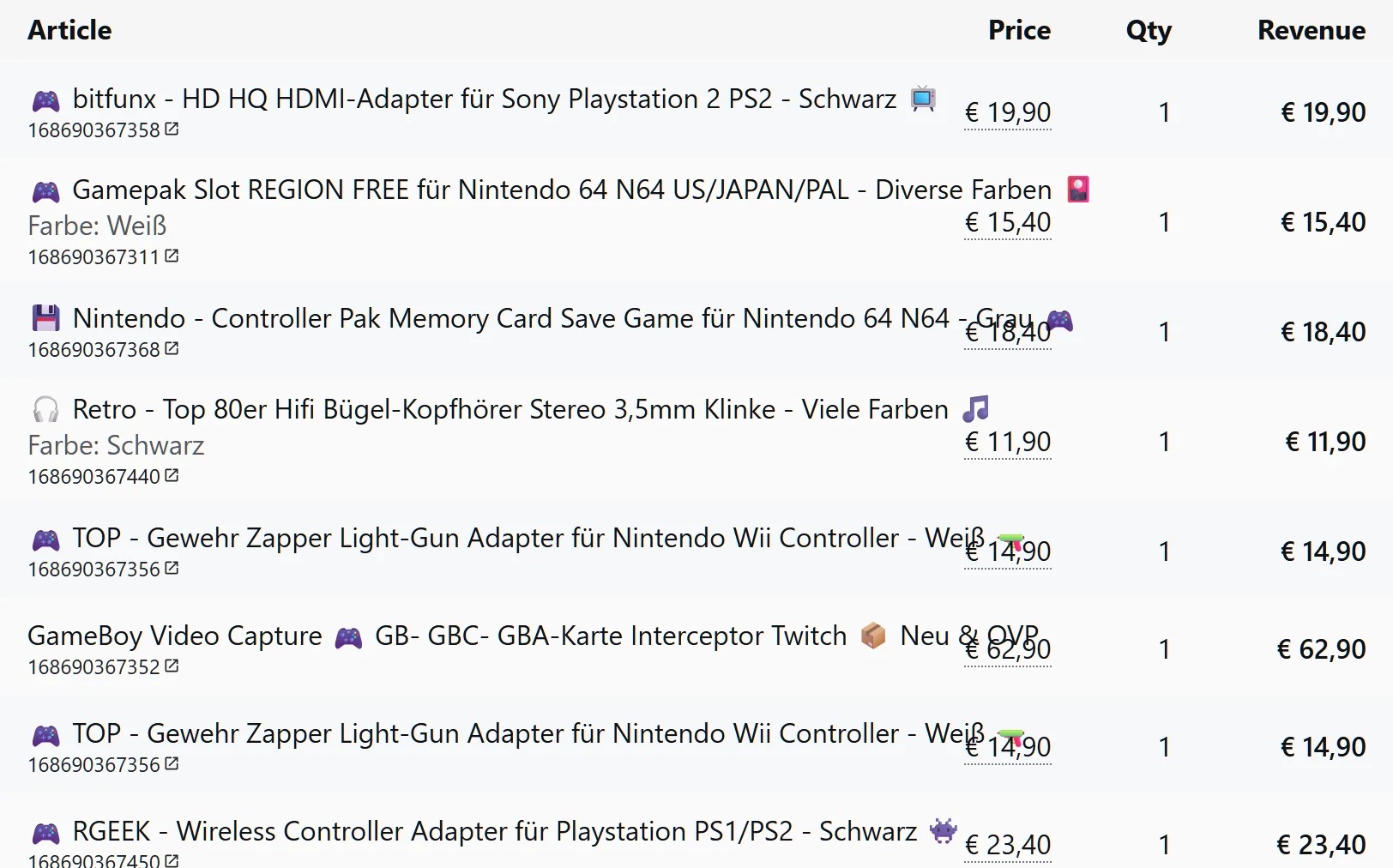
The order timeline, with the money on it.
Each order carries the article, the quantity and the revenue, and the period totals sit above. The same screen is where you read the per-item margin, because that is where both halves of it meet.
Questions, answered
Can I mark an order as shipped from here?
No. We read and analyse orders. Marking shipped, buying a label and messaging the buyer stay in the marketplace and your carrier account.
How far back does the order history go?
Up to 730 days, which is the full history the marketplace exposes. Recent orders refresh frequently; older ones are retained rather than re-read on every run.
How is the margin on a multi-variation order calculated?
Per line. Each variation keeps its own identity and its own cost, so a size and a colour in one order are measured separately rather than averaged into one misleading figure.
What does the import summary show?
Refunds, blocked items and totals that do not match their lines — each with its own entry. An import that reports a problem is more useful than one that returns a clean list with something missing.
Go deeper
- Operations — Orders inside the wider picture: fees, stock and shipping presets.
- Listings, fees and costs — The other half of the same question — what it costs to keep a listing running.
- Analytics and reporting — Where the order data turns into sales statistics and PDF reports.
Back to operations
See the margin on your last thirty sales.
Connect eBay and the first sync builds your order history. The realised margin appears per item against what you really paid.
Get Started