Home / Market intelligence
Market intelligence
Know what the market is doing before you move a price.
Comparable offers from your home market, measured as a reference you can defend. And a read of a competitor's shop: their price spread, their categories and where their listings are weak.
Market data is easy to get wrong in two directions. Look at the cheapest offer and you will price below somebody dumping stock, or below one hiding expensive shipping behind a low headline price. Look at the average and you price above a market that has moved. The useful answer sits between them: a comparable offer with shipping included, taken second-cheapest, then checked by somebody who knows the product.
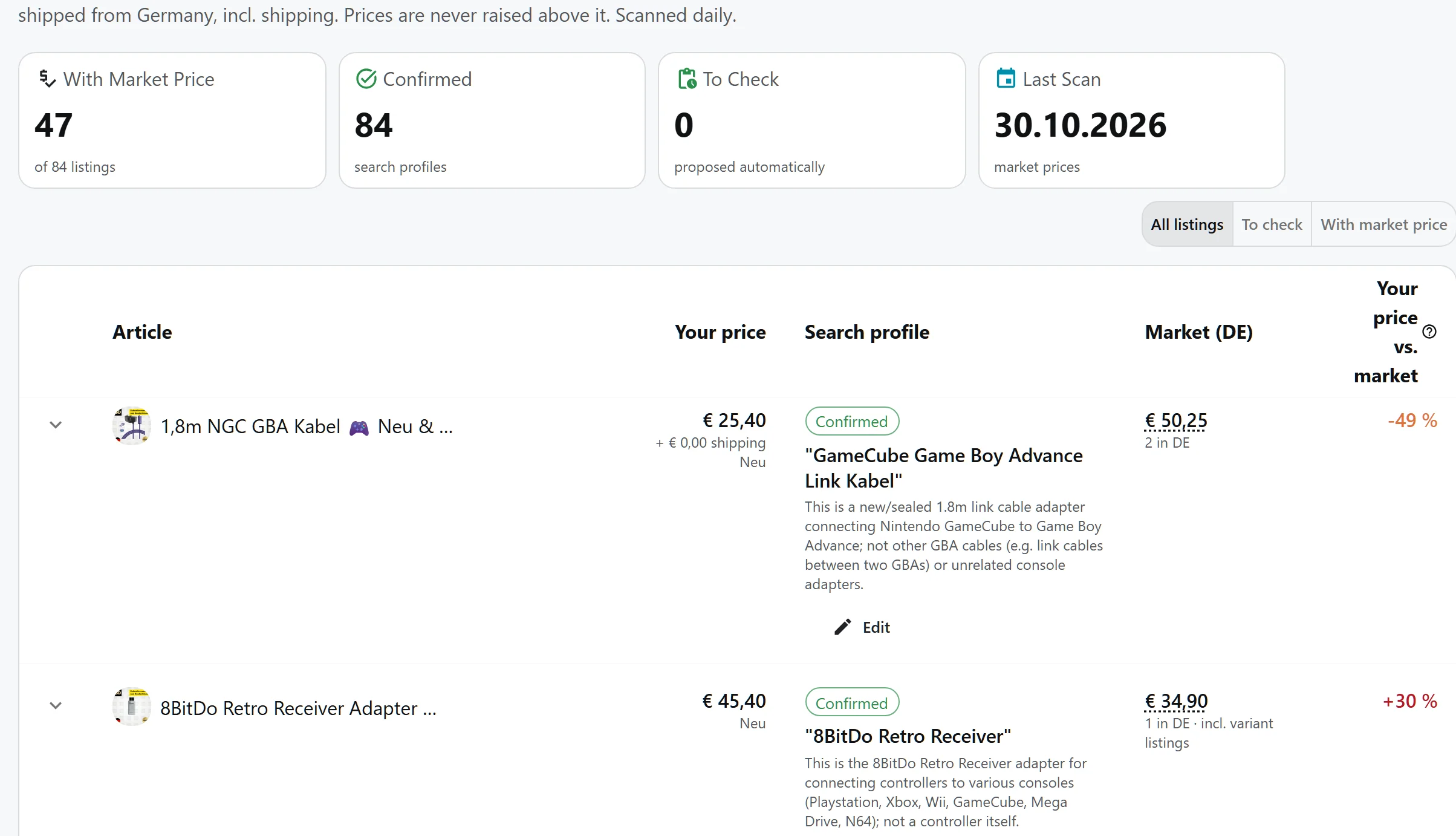
The market, per listing.
Your price next to the market price, and the gap between them in percent. The search profile behind each number is readable and editable, so a benchmark can be argued with instead of trusted blindly.
Two ways of reading the market.
- A reference per listing — Each listing gets a search profile and a market reference: the second-cheapest comparable offer from your home country, shipping included. A single outlier cannot set your benchmark.
- A shop, read as a whole — Point the screening at a competitor's username and get their price statistics, their category spread, how often they ship free and how their listings read. The fastest way to understand why a competitor is cheaper than you.
What this data cannot tell you.
- No sales figures — The marketplace does not publish units sold or revenue. Screening reports prices, structure and listing quality — it never invents a competitor's turnover.
- One shop at a time, capped — A run reads up to a hundred items from a shop, across up to ten pages per category. Enough to read a strategy, not a full archive.
- The official channel only — Screening goes through the marketplace's own official channel. No scraping, no logged-in sessions, no request patterns that put your account at risk.
- You confirm the matches — You get a match proposal with a confidence score, and anything under the threshold is not used. A wrong match is worse than no reference.
How it feeds back into pricing.
- 01. Profile — Give a listing a search profile. The system proposes candidates; you confirm which offers are genuinely comparable.
- 02. Benchmark — The confirmed offers become the market reference beside your price, filtered to your home market if you want.
- 03. Act — The pricing view uses that reference when it builds a recommendation. A competitor move shows up as a changed input, not as a surprise next month.
Questions, answered
Can it tell me how much a competitor sells?
No, and any tool that claims to is estimating. The marketplace does not publish units sold or revenue. What you get is their pricing structure, their category spread, their shipping policy and the quality of their listings — which is usually what explains their position anyway.
Why the second-cheapest offer instead of the cheapest?
Because the cheapest is frequently a listing you should not be measured against: a clearance seller, a different condition, or a headline price that hides expensive shipping. The second-cheapest comparable offer from your home country is harder to distort and easier to defend.
Is competitor screening allowed by eBay?
It uses the marketplace's own official channel — the sanctioned way to read public listing data. Nothing is scraped and no seller account is used to read another seller.
Do I have to confirm every market match myself?
You confirm the ones the system is unsure about. Above the confidence threshold a match is proposed as ready to use, and your verdict always overrides the model — including when you override it in the other direction.
Go deeper
- Competitor screening in detail — What a run reads, the caps that apply, and the statistics it produces.
- Price intelligence — How the market reference becomes a recommended price with a floor and a ceiling.
- Analytics and reporting — Your own numbers: sales, prices, stock and PDF reports.
Read one competitor before you read another price.
A username is enough. The run is capped, official and returns prices, structure and listing quality.
Get Started