Home / Sourcing
Sourcing
Bring the supplier catalogue in without retyping it.
Give 40thieves an item ID or a product URL and it pulls the images, attributes and price — then keeps the price current, so the cost you plan against is the cost you checked.
Sourcing is three jobs in one. You find the product. You find out what it really costs. And later you find out whether that was still true. Most of the time goes into the second — because the list price is the number that looks good, and the number that matters is the one after the coupon, the coins, the shipping and the import duty. 40thieves imports the product and keeps that number under watch.
What an import looks like on arrival.
Imported orders and the products behind them, with the price you really paid. This is the number your margin is measured against.
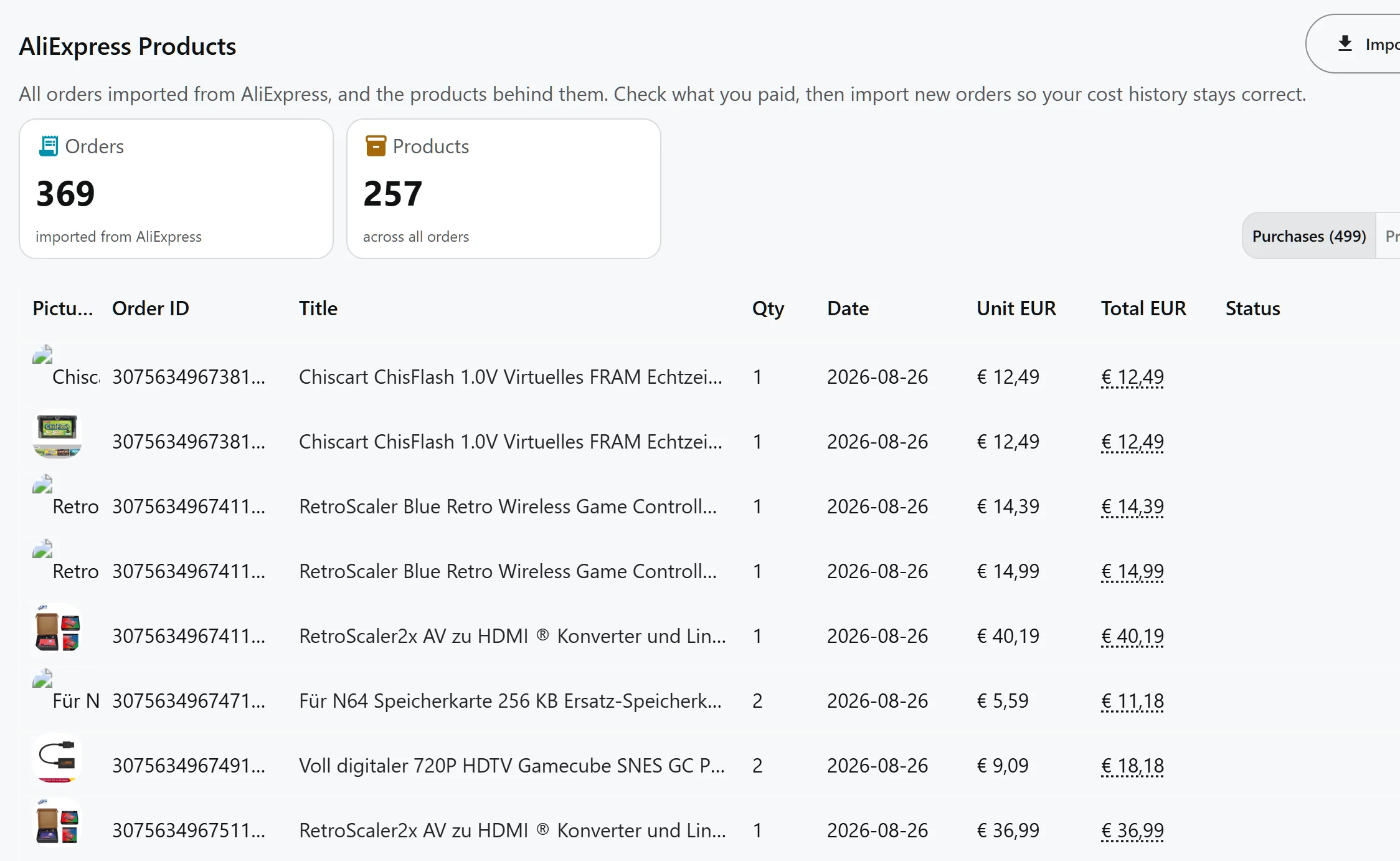
What an import brings back.
- The product, complete — Title, variants, attributes, the full image set and the current price. The same product imported twice is recognised, not duplicated.
- What you actually paid — From list price through coupons, coins, shipping and import duty, down to the amount charged. That figure — not the list price — is what your margin is built on.
- A price that stays checked — We refresh supplier prices twice a day. If a price moved while you were not looking, the change is in the system before it is in your listing.
How an import runs.
- 01. Point — Paste item IDs or a product URL. A whole list comes through in one run — no tab per item, no copy and paste per field.
- 02. Fetch — The supplier is asked directly. If it cannot answer cleanly, a fallback reads the product page — and if something blocks the way, the job stops and says so instead of returning half a product.
- 03. Sort — 40thieves puts variants, attributes and prices into one clean shape. Every later step reads that shape, so nothing else needs to know where the product came from.
- 04. Keep watching — The item stays under price observation. A change on the supplier side becomes a visible change here, with the history to show when.
One supplier today, more by design.
AliExpress is the connected supplier. We built the machinery behind it — fetch, sort, deduplicate, price-watch — for any supplier, so each new one is another way in rather than another system.
In practice: an import lands in the same catalogue no matter how it arrived, and everything after it — images, drafts, price advice — reads that catalogue. A second supplier would not need a second pipeline.
Questions, answered
How current are the supplier prices?
Refreshed twice a day at fixed times. A price you see is at most half a day old, and the screen shows when the last run happened.
What happens when the supplier blocks the request?
The job stops and reports the reason. An import that cannot finish says so — it never hands you a product with missing images or a stale price and lets you find out later.
How much can I import in one run?
The import itself takes as many item IDs as you give it. The work behind it — listing, images, draft — runs fifty items at a time, so one failure costs you fifty rather than the whole run.
Does it import products from other supplier platforms?
AliExpress is the only connected supplier today. The import also accepts a generic product URL and an eBay item ID from another seller, which covers a good part of real sourcing work.
Go deeper
- The AliExpress import in detail — Two imports, one connection, and the order history with real paid costs.
- Product import by URL or item ID — Three ways in: a supplier item ID, a product page, or a listing from another seller.
- Product preparation — What happens to an imported product before it is ready to list.
Import one product and see what comes back.
An item ID is enough. The images, the attributes and the price history arrive in one run.
Get Started